 Developer
Institute
Case study · Game for social impact · 2026
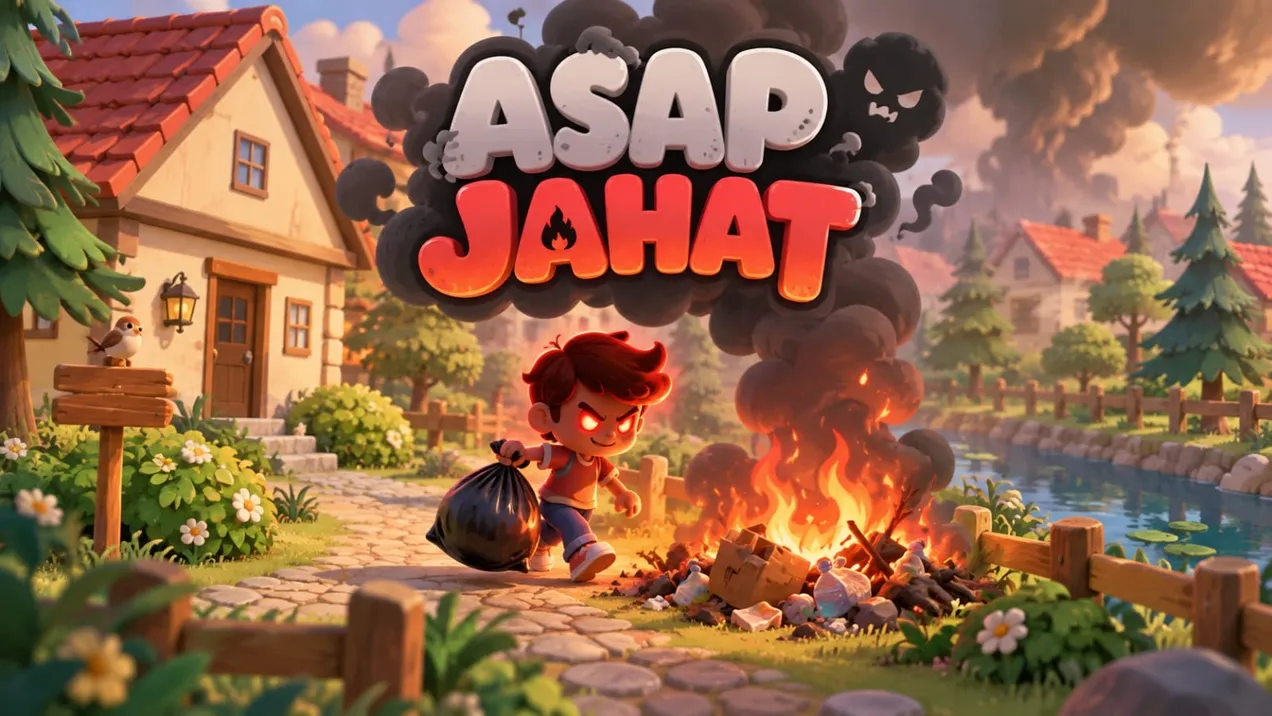
Asap Jahat
The smoke next door, as a game.
A game that shows Jakarta residents how illegal waste burning feeds air pollution, and what they can do about it. Designed in three days at the Apple Developer Institute course Designing Games for Learning & Social Impact.
- Role
- UI/UX Designer
- Course
- Designing Games for Learning & Social Impact
- Host
- Apple Developer Institute @ BINUS University
- When
- 9 – 11 Sep 2026
- Team
- 5 members
- Method
- Transformational Framework (Sabrina Culyba)
Choosing the problem
Pick the part of air pollution any resident can act on.
Jakarta’s biggest polluters are traffic, private cars and motorbikes, and a lack of public transport. None of those can be fixed by a game, or by one resident. So we looked for a cause that happens on your street, that is already against the law, and that anyone can do something about: illegal waste burning.
5
topics on the table
The course gave us five social issues. We picked air pollution.
4/5
of us live in Jakarta
We breathe it every day, so we started from what we see around us.
Rp500k
fine for burning waste
Jakarta bans it (Perda DKI 3/2013, Art. 126 e), and residents can report it in the JAKI app.
Sources: Jakarta Smart City · Fortune IDN
Transformational Framework
What should change in the player?
The course used Sabrina Culyba’s Transformational Framework: decide how the player should be different after playing before designing any mechanic.
Goal
Increase knowledge of what causes air pollution and how to tackle it.
Audience
Young parents in Jakarta and its satellite cities, living next to smoke from illegal waste burning.
Change
After playing, the player knows the causes and how to respond to them.
Domain
Waste burning: one cause a single resident can actually see and act on.
Barriers
-
01
They don’t know the causes
Burning waste, private vehicles and smoking all add up, but few people connect them.
-
02
Burning feels practical
Throwing it on a fire is easier than proper disposal, especially when collection fees are high.
-
03
No one gets caught
Offenders rarely face consequences, so the ban feels like it doesn’t exist.
The game
When a fire starts next door, the player decides what to do.
01
Warn the neighbour
The softest response. Talk to the person burning before the smoke spreads to the rest of the street.
02
Put out the fire
Spend in-game money to put out a fire before the smoke pushes up the city’s ISPA (respiratory infection) meter.
03
Report it
Tap the offender before their timer runs out. Reporting earns the biggest reward, just like the real channels: JAKI and SP4N-LAPOR!.
Why a tycoon game
We explored a tycoon-style format, where money, levels and the city’s air all move with your choices, so every decision has a visible effect.
3
ways to respond to a fire
Low-fi mockup
Sketching the loop, not the pixels.
The course was three days and focused on ideation, so there’s no hi-fi design. These low-fi frames were enough to agree on the game loop, the learning moments, and how we’d measure if it worked.
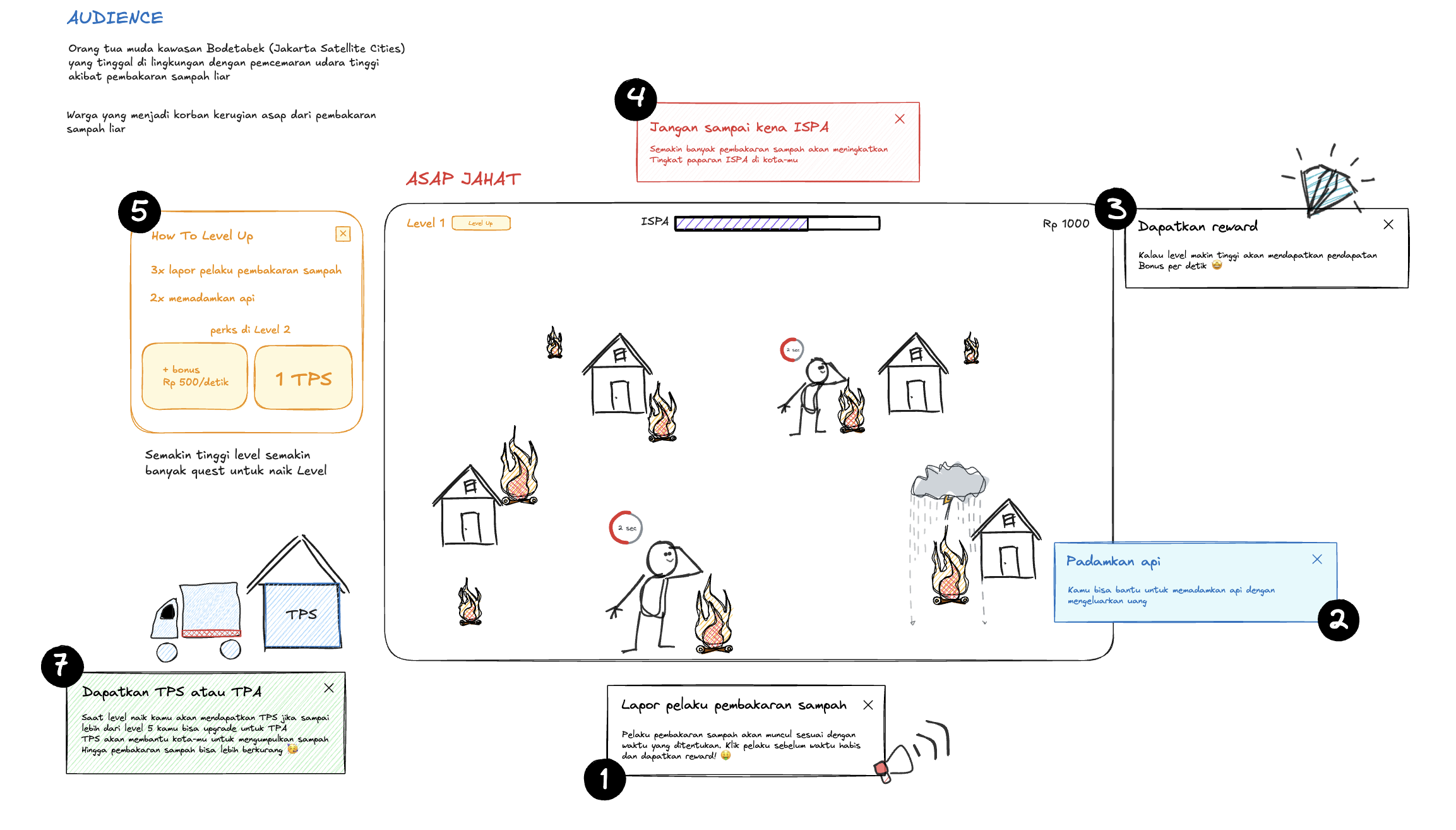
The game screen · tap to zoom ↗
-
1
Report offenders
Tap the person burning before the timer runs out to earn a reward.
-
2
Put out fires
Spend money to put out a fire.
-
3
Earn more as you grow
Higher levels add bonus income every second.
-
4
Watch the ISPA meter
The more waste burns, the higher the city’s ISPA exposure.
-
5
Level up
Report 3 offenders and put out 2 fires. Level 2 adds +Rp500/sec and a TPS (waste depot).
-
6
Learn between levels
A short popup explains one fact each time you level up.
-
7
Build a TPS, then a TPA
The depot collects waste for the city, and becomes a TPA (landfill) after level 5.
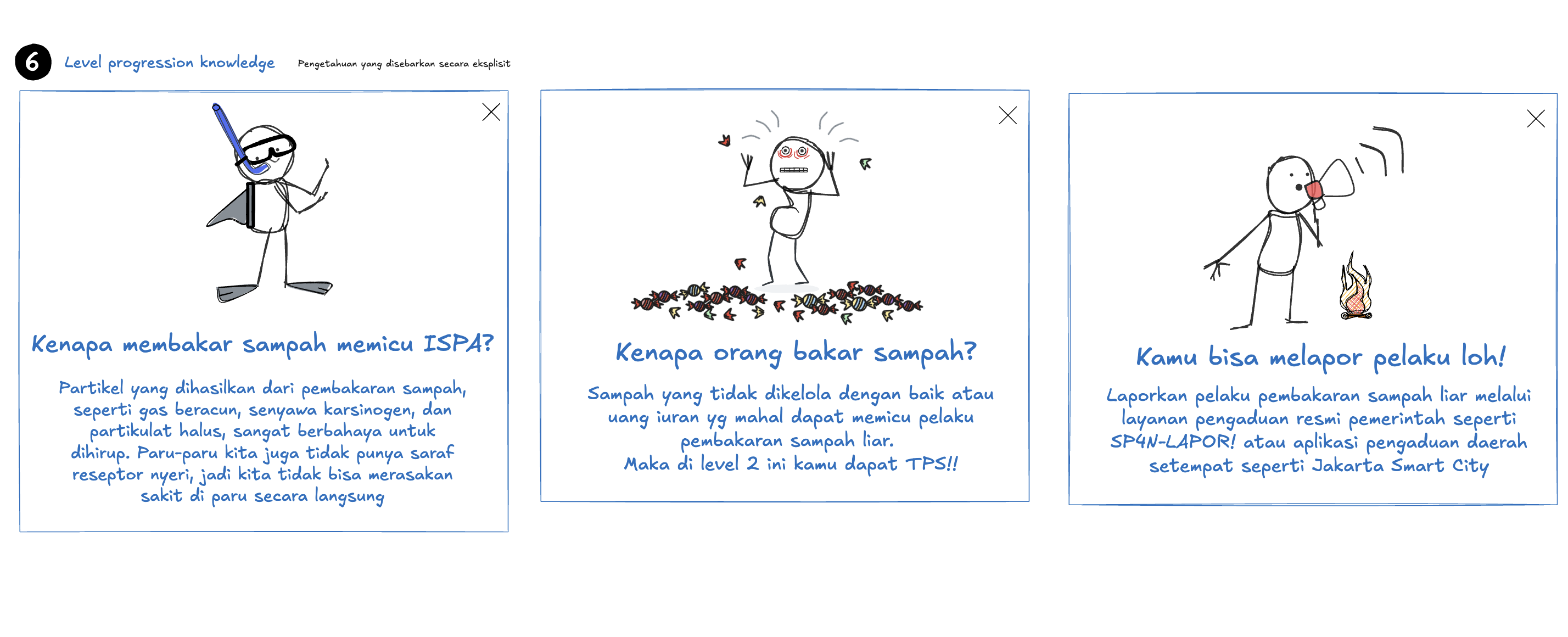
Level progression knowledge · tap to zoom ↗
Why burning causes ISPA
The smoke carries toxic gas and fine particles, and lungs have no pain receptors, so you don’t feel the damage.
Why people burn waste
Poor waste management and expensive collection fees. That’s why level 2 gives you a TPS.
You can report it
Through official channels like SP4N-LAPOR! or Jakarta Smart City.
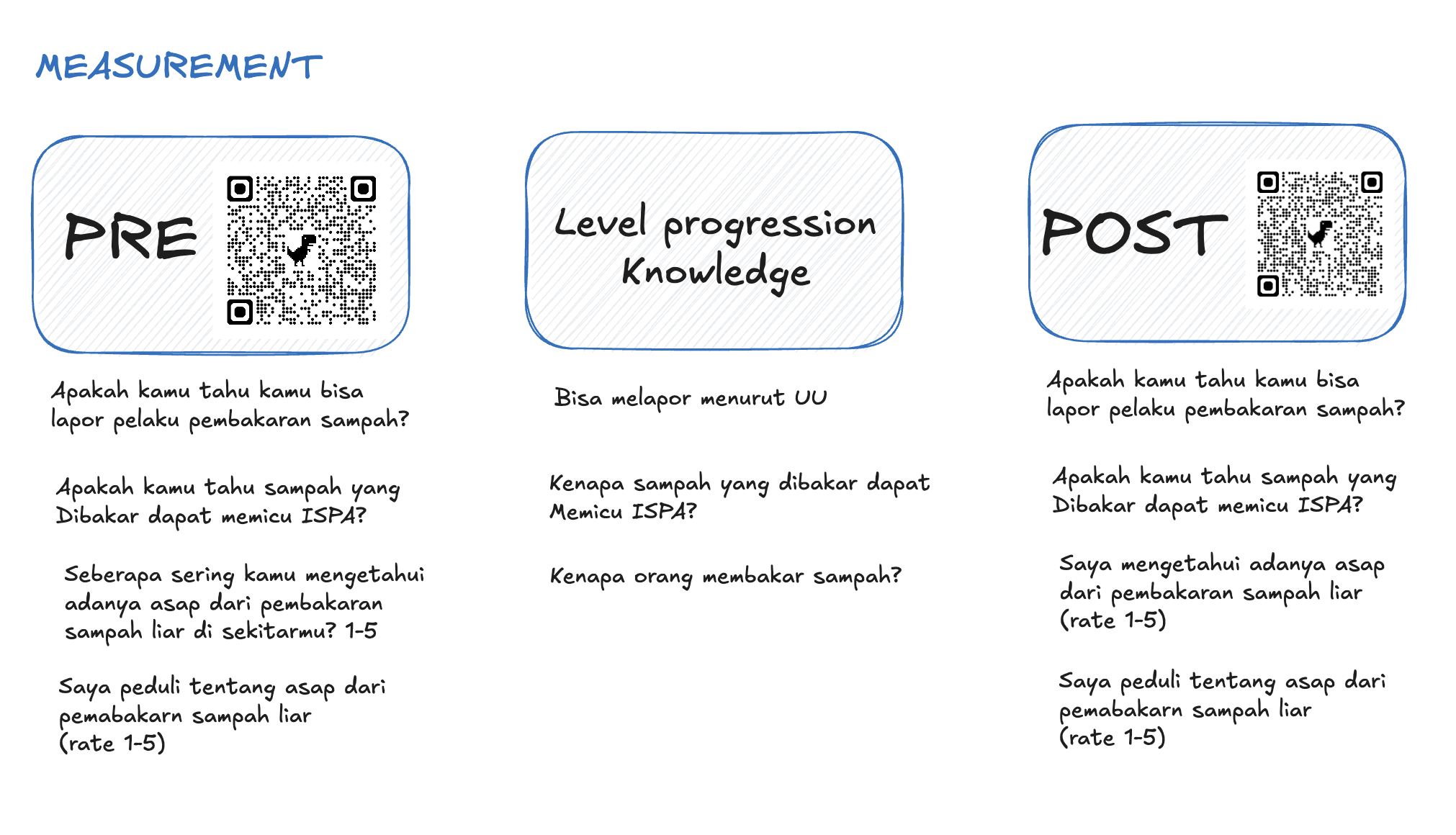
Measurement · tap to zoom ↗
Players scan a QR questionnaire before and after playing. The same questions are asked both times: do you know you can report people who burn waste, do you know burning waste causes ISPA, how often do you notice the smoke, and how much do you care about it (rated 1–5). The difference shows whether the knowledge popups landed.
The team
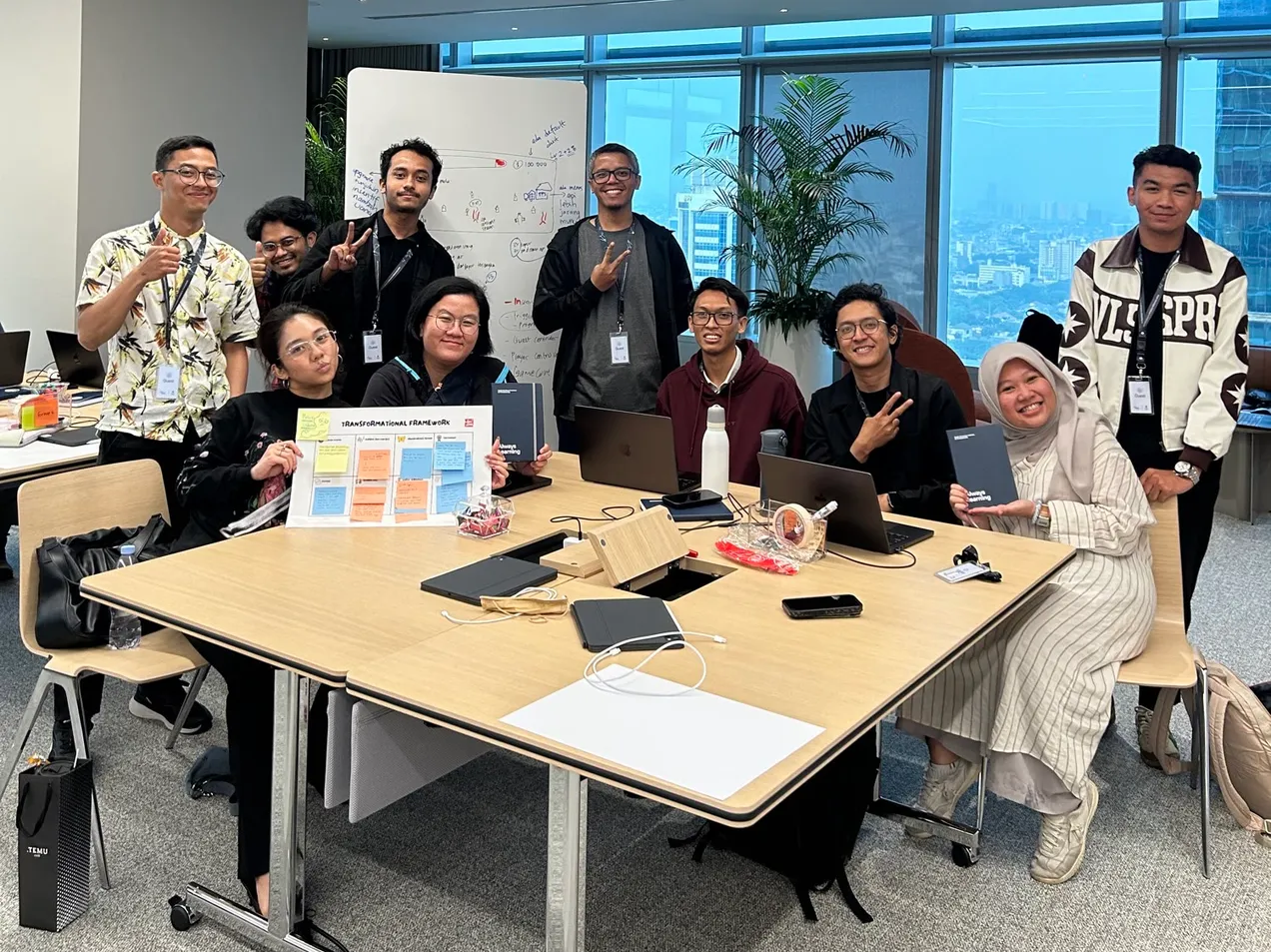
Three days, one table, plus our mentors.
What I learned
Target one behaviour, not the whole problem.
A game for change works best when it targets one behaviour the player can actually perform, rather than the whole problem.
Planning the measurement early, with the same questions before and after playing, made it clear what each level had to teach.